

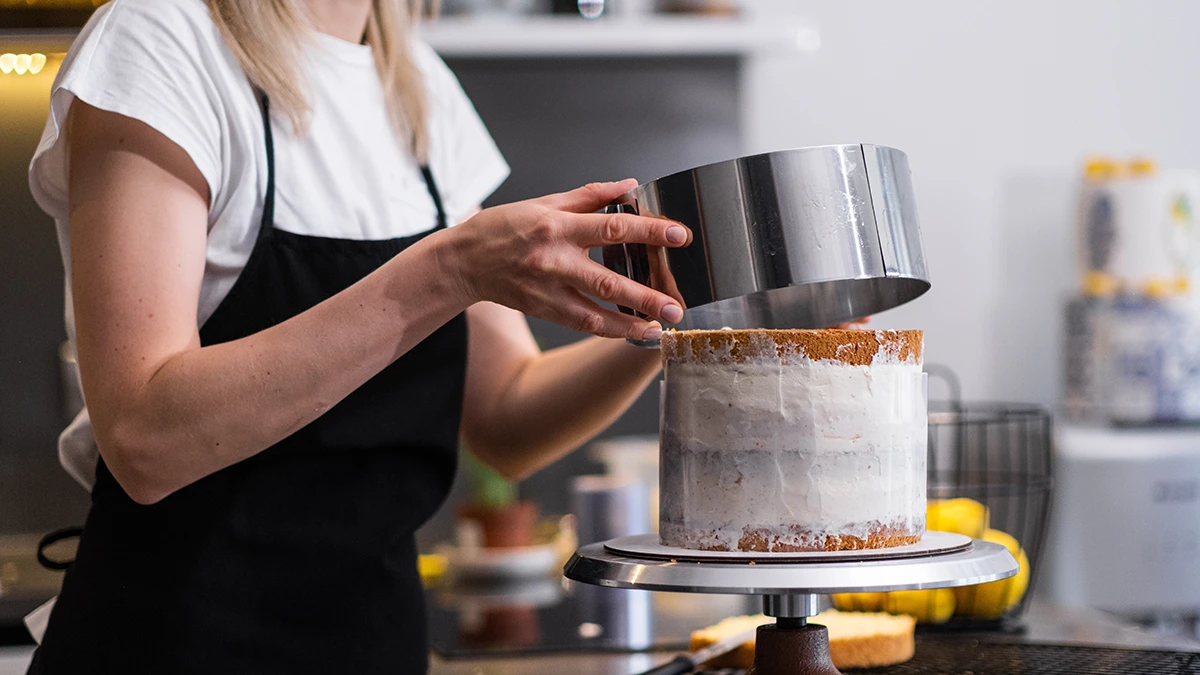
In short: A bottomless ring stands on a tray lined with parchment or a silicone mat, and that lining serves as the base. Professionals mostly work with rings from 16 to 20 cm. To release the cake, run a knife around the inside of the ring.
Why bakers prefer rings
The shelves are full of tins and rings, which is confusing when you are starting out. A ring is the ideal piece of kit for sponge cakes: a metal band with no base, made in a range of sizes. Professionals most often use 16 to 20 cm. Expandable rings are also sold.
Rings are convenient in use: they need no greasing and wash easily. They suit tall sponges especially well, because the sides are the same all the way round with no seam to interrupt the rise.
Setting up the ring
Place the ring on a baking tray lined with parchment or a silicone mat — the lining is the base. For a loose batter, wrap the outside of the ring in foil so nothing escapes underneath.
Releasing the cake
Let the sponge cool, then run a thin knife around the inside of the ring, keeping the blade against the metal rather than the cake. Lift the ring straight up. Nothing needs to be turned out or flipped, which is why the ring gives cleaner edges than a springform tin.
Frequently asked questions
What goes under a bottomless ring
Parchment or a silicone mat on a baking tray. For loose batters, wrap the outside of the ring in foil as well.
Which diameter should I buy
16–20 cm covers most home baking. An expandable ring is convenient but holds a perfect circle less reliably.
Why is a ring better than a springform tin
Even sides and no seam. A sponge rises more evenly because the wall is identical all the way round.