

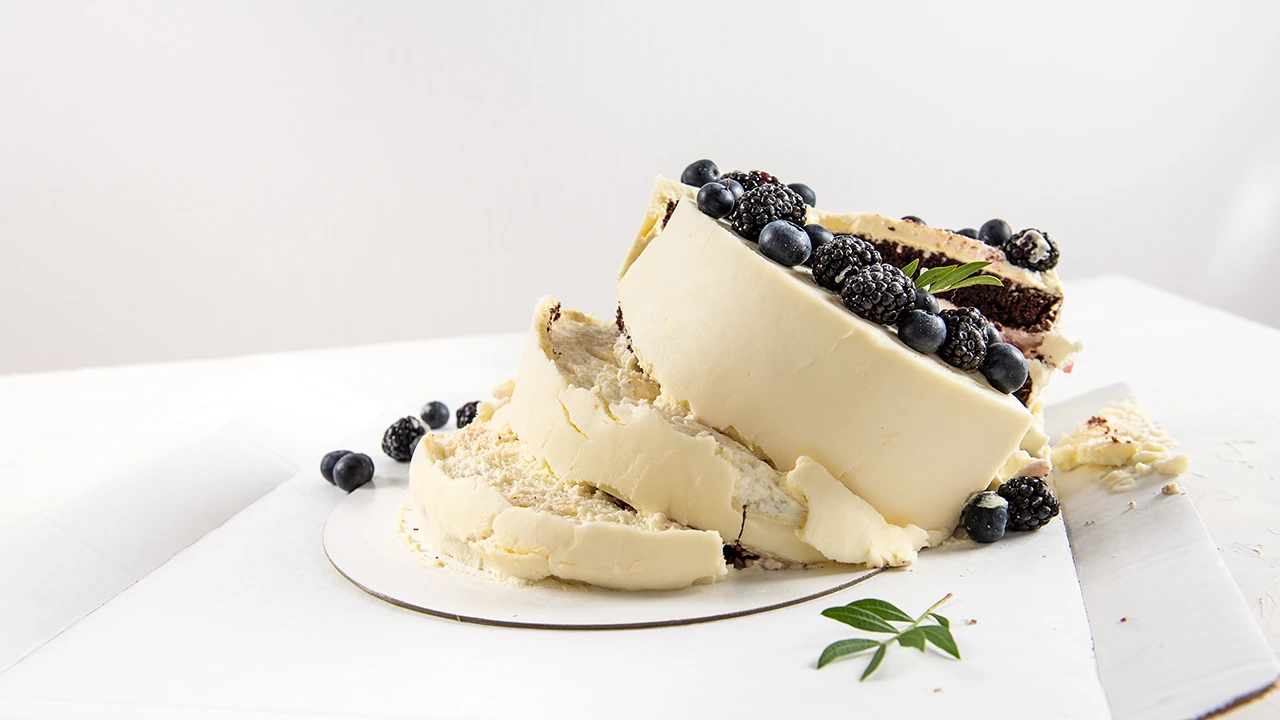
In short: Transport a cake chilled, flat and on a non-slip mat — in the boot, not on a seat. Tall and tiered cakes are assembled on site, with supports between the tiers.
Before you move it
Chill the dessert in the fridge for at least three hours. A cold cake is firm; a room-temperature one deforms at the first corner. This single step prevents most transport damage.
Tiered cakes
Use rigid boards — extruded foam or wood — when assembling heavy cakes: they are strong enough to carry the load. Fix a two-tier cake to its board with a little frosting, and tape the board to the bottom of the box with double-sided tape.
A multi-tier cake is better carried disassembled and put together at the venue. Supports between tiers are not optional: without them the lower tier carries the full weight and slowly compresses.
In the car
Carry the box on a flat surface — the boot floor or the floor behind a front seat — on a non-slip mat. Seats are angled, and an angled cake travels sideways. Run the air conditioning in hot weather and avoid sharp braking.
On a plane
Only in hand luggage, only a dense chilled cake, and only in a rigid box. Mousse cakes and anything with an unstable frosting will not survive the trip.
Frequently asked questions
Where in the car should a cake go
On the flat floor behind a front seat or in the boot, on a non-slip mat. A seat is angled and the cake will slide.
Can a cake be taken on a plane
In hand luggage, dense, well chilled and in a rigid box. A mousse cake will not survive it.
How do I transport a cake in hot weather
Chill it as hard as you can beforehand, use a cool bag with ice packs and keep the air conditioning on.