

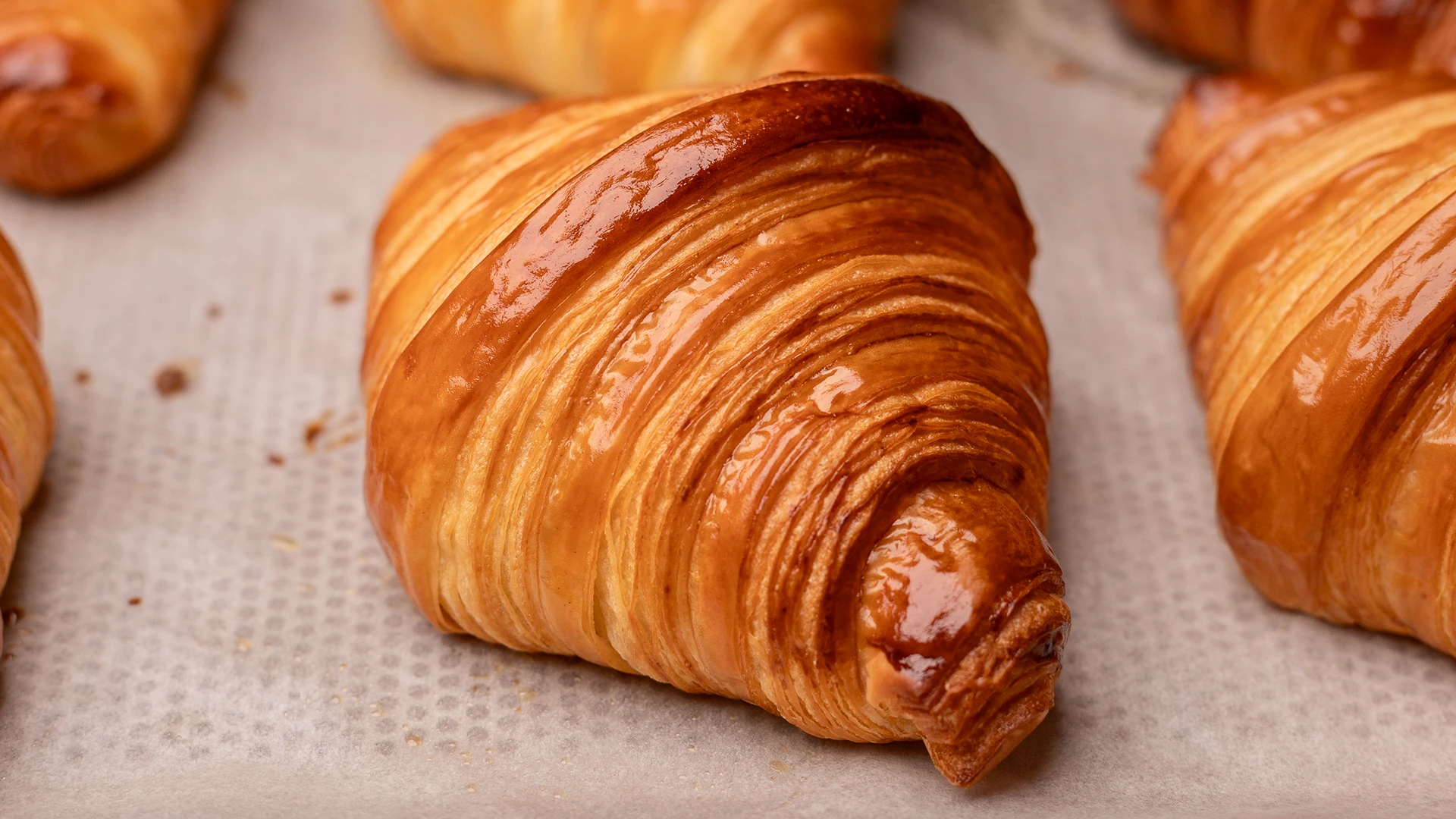
In short: An open honeycomb crumb and a crisp crust come from three things: dough and butter at matching plasticity around 14–16 °C, three simple folds without tearing the butter layers, and a full prove at 24–26 °C until the piece visibly trembles when the tray is moved.
Why croissants are the measure
Croissants have long since won over food lovers worldwide. They can be eaten morning, noon or night, and the filling inside laminated dough can be almost anything — which is why they turn up everywhere and why getting them right is a benchmark.
Matching butter to dough
The single most common failure. Butter colder than the dough shatters and punches through the layers; butter warmer than the dough smears into it and the layers merge. Both should be pliable at around 14–16 °C: bendable without cracking.
Three simple folds
Three simple folds give 27 layers of butter, which is enough. More folds make the layers thinner until they merge, and the crumb turns dense rather than open. Rest the dough cold between folds so the gluten relaxes and does not fight the rolling pin.
Proving properly
Prove at 24–26 °C and no warmer. Above that, the butter melts out and pools on the tray before the piece has finished rising. The croissant should roughly double and wobble noticeably when you move the tray — that wobble is the signal it is ready.
Baking
Into a properly hot oven. The steam trapped between the layers is what pushes them apart, and a lukewarm oven lets it escape before it can do any work.
Frequently asked questions
Why does butter leak out of my croissants
The butter melted during rolling, or the prove was too warm. Keep the dough cool and prove no higher than 26 °C.
How many folds do croissants need
Three simple folds, giving 27 layers of butter. More folds thin the layers and the crumb becomes dense.
Why is my crumb dense instead of open
Usually under-proving. The piece should roughly double and wobble visibly before it goes into the oven.