

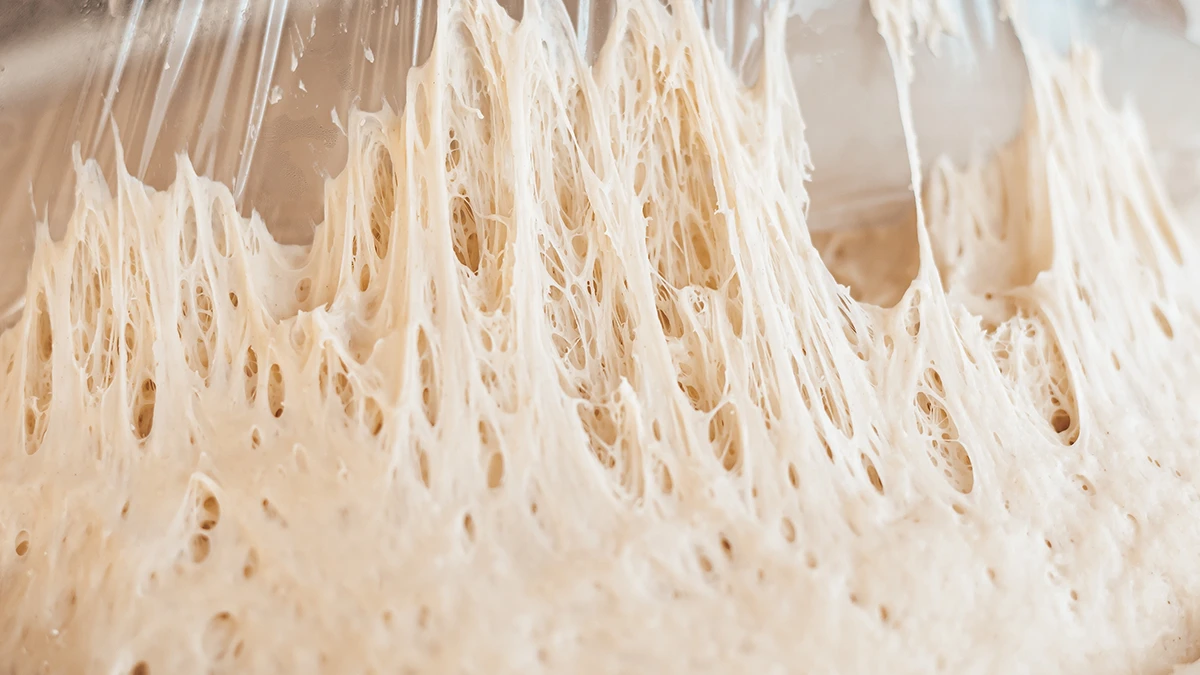
In short: Dough fails to rise for four reasons: the yeast is dead, the liquid was hotter than 45 °C and killed it, there is too much salt or sugar, or the room is colder than 22 °C. The yeast itself can be checked in ten minutes with warm water and sugar.
1. The yeast
It goes without saying that without yeast, yeasted baking will not rise. So make sure you have some — fresh or dry — and always check it for activity first.
To do that, drop the yeast into warm water or milk with a little sugar and flour. If the mixture bubbles and grows in volume within fifteen minutes, the yeast is alive.
2. The temperature of the liquid
Be careful with the liquid used to activate the yeast. Too hot and it kills the culture outright — above 45 °C there is nothing left to ferment. Too cold and the yeast simply stays dormant.
The working range is 35–38 °C: warm to the touch, never hot.
3. Too much salt or sugar
Both bind water and slow fermentation, and salt in direct contact with yeast inhibits it. Salt goes into the flour, not into the yeast slurry. Heavily sweetened doughs need osmotolerant yeast, which is bred for that environment.
4. The room is too cold
Below 22 °C fermentation slows to a crawl, and what looks like failure is often just a dough that needs several more hours. The comfortable range for proving is 24–28 °C; above 30 °C the dough over-ferments and loses structure.
Frequently asked questions
What temperature should dough prove at
24–28 °C. Below 22 °C fermentation slows sharply; above 30 °C the dough over-ferments and collapses.
Can salt kill yeast
Direct contact with concentrated salt inhibits it. Add salt to the flour, never to the yeast slurry.
How long before I give up
An hour and a half to two hours at room temperature. If the volume has not changed at all by then, the dough will not rise.