

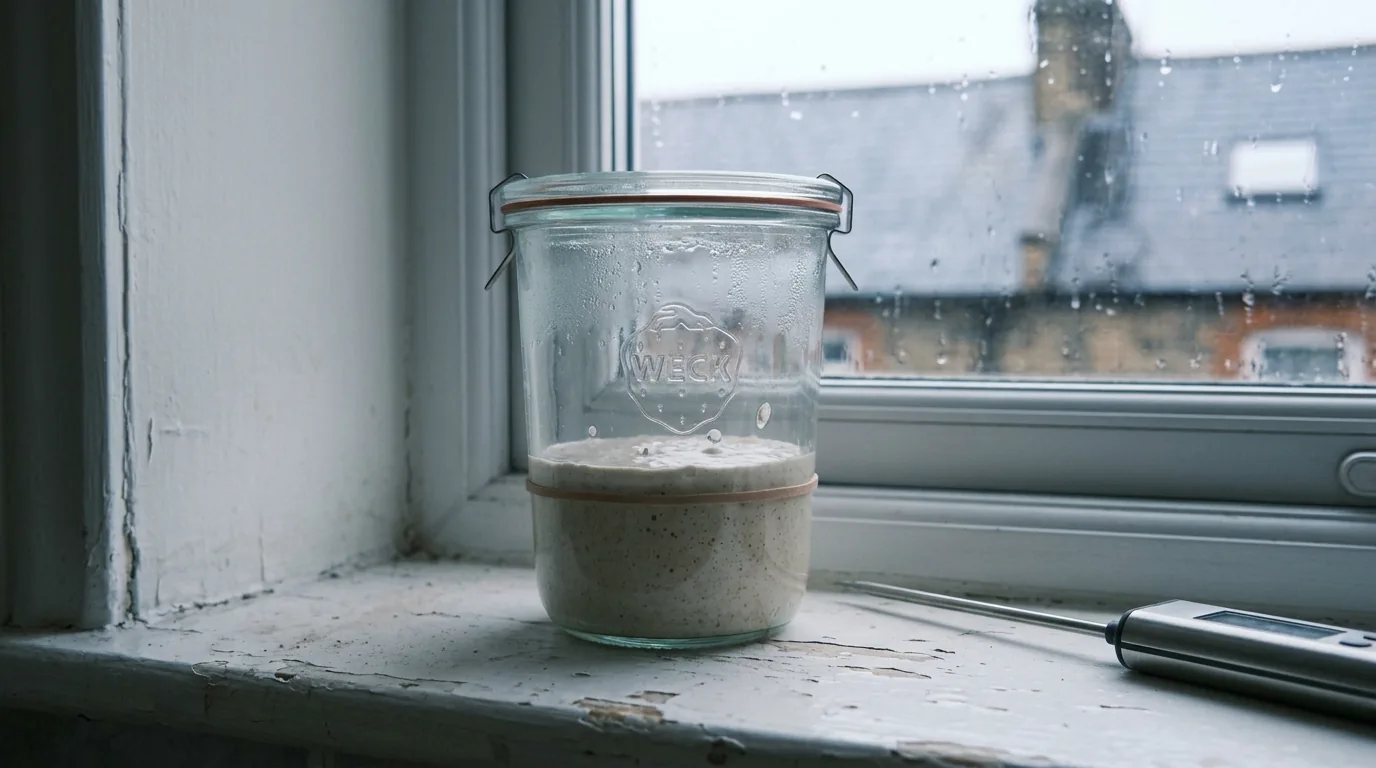
In short: If your starter is less than a week old, a stall on day three or four is a normal stage, not a failure: the first bubbles come from bacteria that later give way to yeast. If the starter is older than a week and still flat, the cause is almost always temperature, flour or feeding frequency.
How long a starter is allowed to sit still
For the first day or two a mix of flour and water often looks lively: bubbles appear, the volume grows. That is not yeast but bacteria, which find fresh flour easy to live in. By day three or four the environment turns acidic, they give way to other microorganisms, and the starter goes quiet. From the outside it looks like the project has died — in fact the population inside the jar is changing.
A normal timeline is five to fourteen days, and the spread depends on flour and temperature rather than on how hard you try. If you are on day six with no rise, give it two more feedings before changing anything.
Seven reasons a starter stays flat
1. The kitchen is cold
The most common cause. A starter is comfortable at 24–28 °C. At 20 °C everything slows down several times over; at 18 °C the rise can be so weak that you never notice it between feedings. In autumn and winter a spot by the window easily sits at 19 °C even when the room feels warm.
What to do: move the jar near the stove, on top of the fridge, into an oven with the light on, or into a cooler bag with a bottle of warm water. A thermometer is more honest than your palm.
2. The flour is wrong
White bread flour is the poorest in microflora: the grain has been stripped of its bran, and most of what should ferment went with it. At the start a culture needs wholegrain or rye flour, where wild yeast and bacteria live in far greater numbers.
What to do: run the starter on wholegrain rye or wheat for the first days and move it to white flour once it rises reliably.
3. Chlorinated tap water
Water is chlorinated precisely to suppress microorganisms, and at the start, when there are few of them in the jar, it shows. Later the culture becomes strong enough not to care.
What to do: draw the water and leave it uncovered for a few hours, or use bottled water. Boiling is not necessary.
4. Too few feedings
Once a day is the minimum, and in a warm kitchen it is not enough: the starter eats through its food, peaks and collapses long before the next feeding. A hungry starter turns acidic, and yeast works poorly in an acidic environment.
What to do: above 25 °C, feed twice a day.
5. Too much old starter in the feed
If you keep adding a little flour and water to a full jar, acidity builds up and the rise fades. Fresh flour has to clearly outweigh the old starter, not the other way round.
What to do: keep a small portion of starter before each feeding and remove the rest.
6. Too runny or too stiff
A runny starter cannot hold gas: bubbles rise and burst, the volume stays flat even though fermentation is going on. A very stiff one does rise, but slowly and almost invisibly.
What to do: keep equal weights of flour and water — the consistency of thick sour cream. That is the easiest version to read for a beginner.
7. You are looking at the wrong moment
A starter can rise and fall while you sleep or work. In the morning you see a flat surface and decide nothing is happening, though the peak was at three in the morning.
What to do: put a rubber band around the jar at the level of the starter right after feeding. The difference in levels shows whether there was a rise, even if you missed it. More on signs of maturity in our guide to telling when a starter is ready to bake.
What to do right now
Change one condition at a time, otherwise you will not know what worked.
First measure the temperature where the jar stands. Below 24 °C, find a warmer spot and give two feedings under the new conditions. If the temperature is fine, switch to wholegrain flour and again give it two feedings. If that does not help either, reduce the share of old starter and move to two feedings a day.
Each change needs two or three cycles: a single day is not enough to draw conclusions. Once the rise appears, you can gradually return to your usual flour.
When starting over is the honest answer
There is one case where it is not worth the effort: fuzzy mould on the surface or under the lid — green, black, white and hairy — or pink and orange streaks. A jar like that cannot be saved by stirring or by scraping the top: the mycelium goes deeper. Everything else — an acetone smell, grey liquid, a sharp sour note — is fixed by feeding rather than by throwing the jar away. See also our notes on improving the quality of a sourdough starter.
If you would rather not do this alone, our sourdough starter intensive takes a culture from flour and water to the point where you can bake on it. From there students move on to the Your Own Bread course.
Frequently asked questions
How many days does a starter normally take
Five to fourteen. Wholegrain rye in a warm kitchen is usually faster; white flour in a cool room takes longer.
My starter bubbles but does not rise — is that normal
Early on, yes: bubbles come from bacterial fermentation, the rise comes from yeast, and the second arrives later. If it lasts more than a week, check temperature and flour.
Can I add commercial yeast to get it going
Then it is no longer a starter but a yeasted preferment: you get the rise, but neither the microflora nor the flavour. The whole point is the wild yeast you grow yourself.
It rose once and then stopped
A classic day three or four picture: the first rise came from bacteria, and the population is now changing. Keep feeding on the same schedule.
What do I do with the starter I remove when feeding
You do not have to bin it — it can be baked with, as long as you account for the flour and water already in it.