

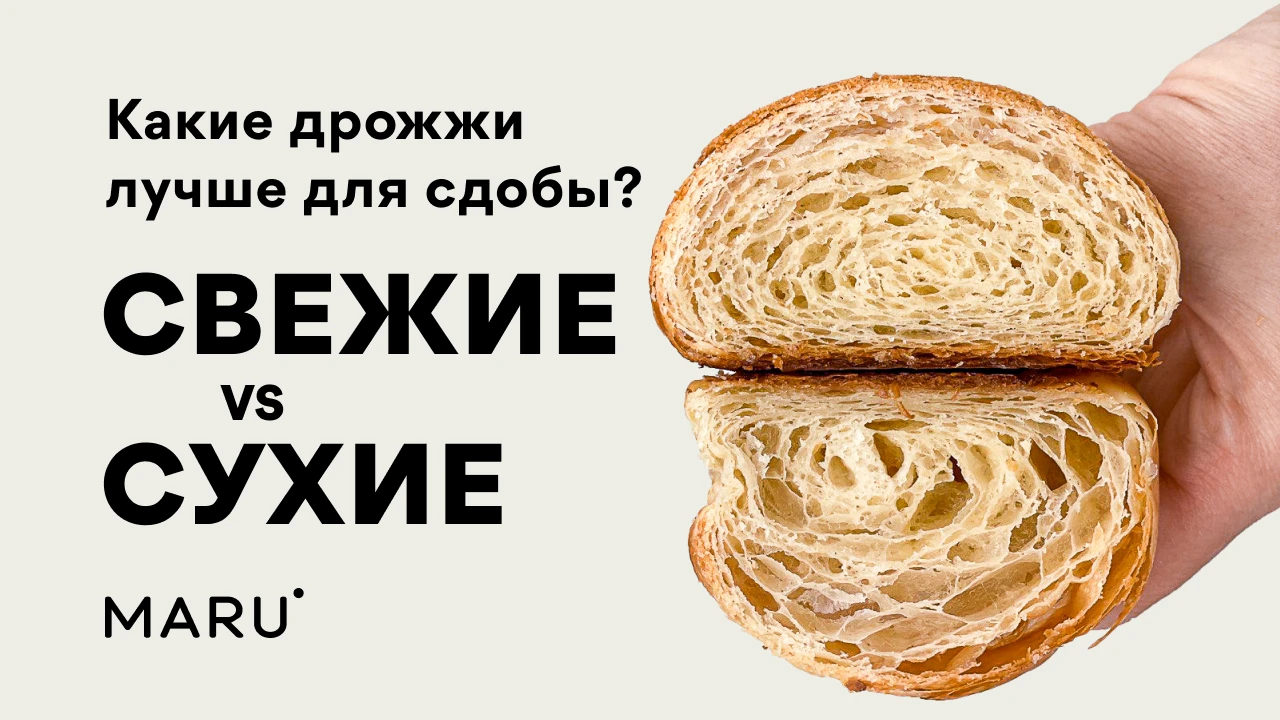
In short: Enriched dough and croissants call for fresh yeast or osmotolerant dry yeast. Ordinary instant yeast is inhibited by sugar and fat, so a rich dough rises slowly on it, or does not rise at all.
Why enriched dough is hard work for yeast
Sugar and fat bind water. In a dough with a lot of enrichment, the yeast cell has less free moisture available than in plain bread dough, and fermentation slows accordingly. That is exactly why osmotolerant yeasts exist — strains bred to work in that environment.
Butter compounds the problem: it coats the flour particles and hinders gluten development, so enriched dough behaves differently from bread dough at every stage. It takes longer to mix and longer to prove.
Fresh and dry compared
Fresh (compressed). Around 70 % moisture, keeps up to two weeks refrigerated. Gives a soft, recognisably rich aroma and behaves predictably in enriched dough. Needs dissolving in warm liquid first.
Instant dry. Goes straight into the flour and keeps up to a year. Convenient, but the ordinary kind is formulated for doughs without much sugar.
Osmotolerant dry. Same format as instant, but bred for enriched dough. The packaging usually says so, or carries the word gold.
Converting between them
Fresh to instant, divide by 3; fresh to active dry, divide by 2.5. Multiply to go the other way. Always convert by weight — a spoonful of dry and a spoonful of fresh yeast are entirely different quantities of cells.
Frequently asked questions
Which yeast is best for croissants
Fresh or osmotolerant dry. Ordinary instant yeast performs noticeably worse in enriched dough.
How do I recognise osmotolerant yeast
By the packaging: manufacturers label it for sweet dough or mark it gold. Ordinary yeast carries no such note.
How much fresh yeast replaces 7 g of instant
About 21 g — instant converts to fresh by multiplying by three.
Sources
- Saf-instant. The Original Gold — recommended from 5 % sugar relative to flour weight