

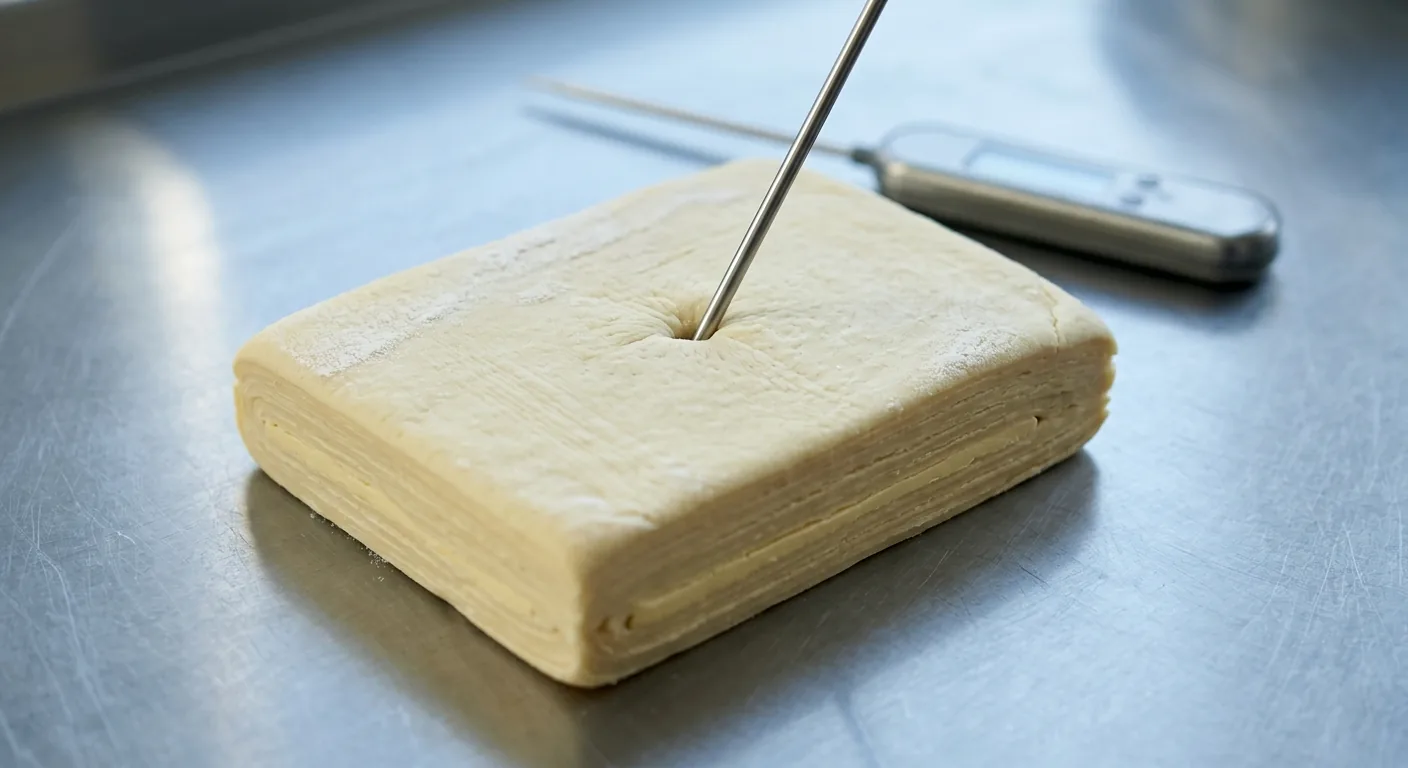
In short: Roll the dough at 4–8 °C, laminate with butter at roughly 13–16 °C, proof at 24–26 °C and no higher, and bake starting around 210–220 °C before dropping to 180–190 °C. Leaving any of these ranges shows up in the pastry immediately.
Why degrees decide everything here
In ordinary bread, temperature governs the speed of fermentation. In yeasted laminated dough it governs whether layers can exist at all: cold butter shatters and tears the dough, warm butter soaks into it and glues the layers together. The working window between those states is narrow, and hitting it is the core skill.
That is why a thermometer beats a timer with laminated dough: the clock tells you when to look, the degrees tell you what to do.
Mixing
Dough should come off the mix cool, usually around 22–24 °C. Overheated dough starts fermenting too early and is slack and hard to sheet by the time you laminate.
At home you control this with water: cold or iced in summer, cool in winter. Chilled flour and liquids help too.
Chilling before lamination
Before the butter goes in, the dough is held at 4–6 °C so it neither warms the block nor fights the pin.
Dough chilled harder than that works worse: it is stiff, tears and presses the butter out. If a sheet has been in the freezer, let it even out in the fridge.
Butter at lamination
Butter is ready at roughly 13–16 °C: it bends without cracking and leaves no greasy smear on your fingers. Test it by bending a corner of the block. Cracks — too cold. Squashes and stretches — too warm.
The central rule fits in one line: dough and butter must be equally plastic. If either is firmer than the other, the layers tear.
Rolling
The working range for the sheet is 4–8 °C. As soon as the surface turns soft and tacky and butter starts showing through, the sheet goes back into the cold for 20–30 minutes.
In a summer kitchen above 26 °C that happens within minutes, so rolling is split into short sessions. A sheet that has gone soft can be saved by chilling; one you kept working cannot.
Proofing
The most underrated stage. Proof at 24–26 °C, 28 °C at the very most. Above that the butter inside melts and runs onto the tray before the oven, the layers lose their boundaries and the pastry collapses.
Below 22 °C proofing stretches into hours, which is not a problem, merely slow. Judge readiness by appearance, not by the clock: the pastry has grown visibly, wobbles when the tray is nudged, and the layers show along the edge.
Baking
Start hot, around 210–220 °C: steam has to form fast and lift the layers before the structure sets. Then drop to 180–190 °C so the inside bakes through without the outside burning.
Too low a start and the layers never lift while butter runs out. Too high with no drop and you get a dark crust over a raw crumb.
A summer kitchen
At 28–30 °C indoors the classic scheme stops working: the dough warms faster than you can sheet it. Early mornings, a chilled pin and counter, smaller batches and more frequent cold rests all help.
If your results are consistently worse in summer, this is almost always why — not the formula.
Frequently asked questions
What thermometer do I need
An ordinary kitchen probe. What matters is measuring the dough itself, not the air in the room.
Can I proof croissants in an oven with the light on
Only if it stays below 26–28 °C. Such ovens often sit at 30–35 °C, and the butter runs.
What do I do if the dough warms up while rolling
Refrigerate it for 20–30 minutes. Continuing with a warm sheet is pointless: the layers are already merging.
Why did my croissants collapse after proofing
Usually over-proofed, or proofed too warm. Both lead to the same result.
Do I have to lower the oven temperature during the bake
It is strongly advisable: the hot start lifts the layers, the drop lets the crumb bake through while the crust keeps its colour.