

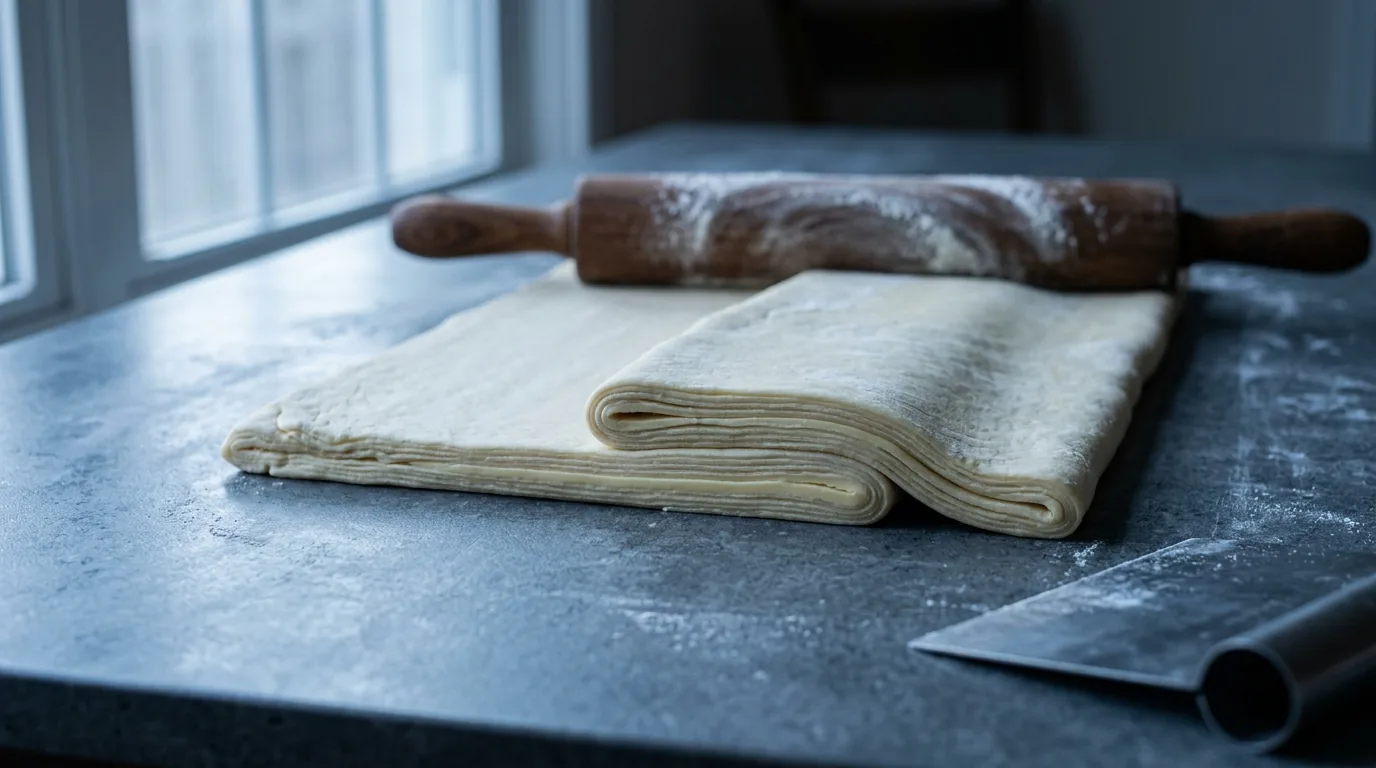
In short: Lamination means alternating thin layers of dough and butter that steam separates during baking. The layers come not from the number of rolls but from how closely the plasticity of the dough matches that of the butter while you work.
What actually happens in laminated dough
Layers of butter sit between layers of dough. In the oven the water in the dough turns to steam, the butter melts and keeps the layers from gluing together, and the steam lifts them apart — that is the open structure you see on the cut. If the layers merged before baking, there is nothing left to lift: you get a bun that tastes of butter.
Hence a simple rule: the baker's job is not to roll thinner but to keep the boundaries between layers intact until the oven takes over.
The butter block
The butter is shaped into an even slab, usually between two sheets of parchment, beaten with a rolling pin and squared off. A neat rectangle is not about looks: an uneven block spreads unevenly, so the layers tear where it is thin and stay greasy where it is thick.
Beating also serves plasticity. Butter straight from the fridge is brittle; warm butter runs. A beaten, squared block bends without cracking and holds its shape — in that state it behaves like the dough itself.
Use butter of at least 82 % fat: the less water in it, the smaller the risk of the layers going soggy.
Folds and layer counts
The block is enclosed in the dough, rolled out and folded. Every fold multiplies the number of layers.
A single fold in three multiplies by three: 3 layers after the first, 9 after the second, 27 after the third. A double fold, where the edges meet in the middle and the sheet is folded in half, multiplies by four.
Classic schemes land between 27 and 55 layers. More is not better: the layers get so thin that they tear and merge, and the cut loses its pattern. Fewer is not better either — thick layers make a coarse pastry.
Why the cold rests
Between rolls the dough goes back into the cold, for two reasons.
The first is butter. It warms from your hands, the counter and the pin; warm butter soaks into the dough and the boundary disappears. Cold restores its working plasticity.
The second is gluten. Rolling tightens it, the dough starts to resist and pulls back. At rest the gluten relaxes and the next roll goes further and more evenly.
A rest is not lost time but part of the process: without it every subsequent roll tears the layers harder than the last.
How to roll
Work from the centre outwards, without leaning on the pin or pressing through in one spot. Alternate the direction: turn the sheet 90 degrees after each fold, or the dough stretches one way only and the layers skew.
Keep dusting flour to a minimum — extra flour lands between the layers and stops them separating. Brush the excess away.
Signs that things are going well: an even sheet, no butter showing through in patches, straight edges, dough that bends without tearing. If butter breaks through, the sheet goes into the cold immediately; carrying on is pointless.
At home without a sheeter
Laminating by hand is entirely feasible and is what every home baker does: you need a pin, a cool flat surface and a willingness to work quickly. The difficulty is not strength but pace — the longer the sheet sits out, the closer it gets to room temperature.
Useful habits: work at the coolest time of day, chill the counter with a tray of ice, split the dough into smaller portions, and do not stretch the rests indefinitely — the dough should not freeze through.
Frequently asked questions
How many folds does a croissant need
Usually three single folds, or a mix of single and double — between 27 and 55 layers. Beyond that the pattern of the cut starts to disappear.
Why does my dough shrink back when I roll it
The gluten is tight and has not relaxed. Rest the sheet in the cold for 20–30 minutes and carry on.
Can I laminate with margarine
Technically yes, and industry does exactly that, but flavour and aroma will differ. Home croissants call for butter of 82 % or higher.
What if butter breaks through the dough
Dust the spot with flour, refrigerate the sheet and let its temperature even out. Do not keep rolling over an open patch of butter.
Do I really need to beat the butter
Yes, otherwise it stays brittle and tears the layers on the first roll. Beating makes it plastic, not soft.