

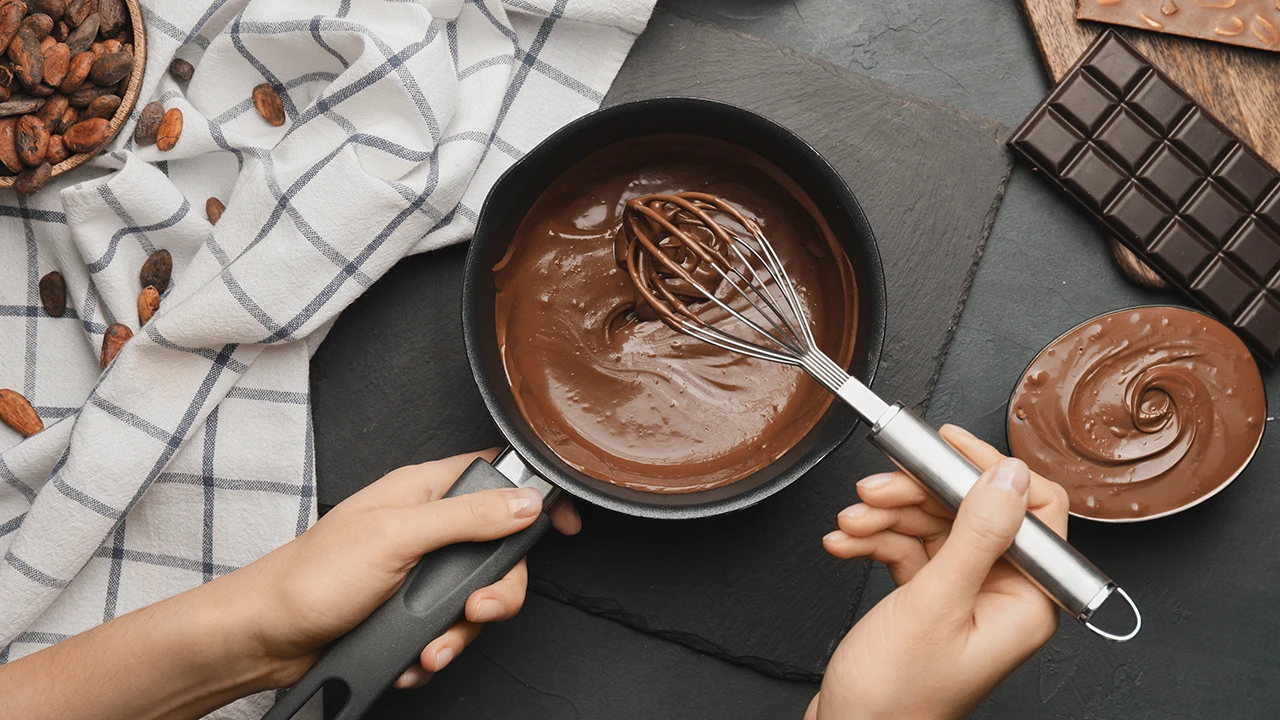
In short: The simplest way to melt chocolate is over a bain-marie with the bowl clear of the water, at no more than 45 °C for dark and 40 °C for milk and white. In the microwave, work in bursts of 15–20 seconds with a stir between each.
Before you start
Chocolate must never be melted at high heat: the cocoa butter it contains will separate into flakes. Use thick-walled glass, ceramic or enamel bowls, and avoid metal ones.
Know your chocolate
Check the composition before you buy — the flavour and the appearance of the finished work depend on it. Good chocolate contains no fats other than cocoa butter.
Dark and bitter. Bitter chocolate is up to 98 % cocoa products and tastes of pure chocolate with no added sugar; dark chocolate contains sugar, so it reads as softer.
White. The only cocoa product in white chocolate is cocoa butter, which is why it is the most heat-sensitive of the three.
The five methods
| Method | How | Watch out for |
|---|---|---|
| Bain-marie | bowl over, not touching, simmering water | steam is water — a drop will seize the mass |
| Microwave | bursts of 15–20 seconds, stirring between | the centre heats first and can scorch unseen |
| Oven | low heat, door ajar, stirring often | easy to overshoot; use a thermometer |
| Hairdryer | warm air over a bowl of chopped chocolate | slow, but very hard to overheat |
| Slow cooker | keep-warm setting | condensation under the lid is the main risk |
Temperature limits
| Type | Maximum | Why |
|---|---|---|
| Dark and bitter | 45 °C | above this the cocoa butter separates and the mass turns matte and thick |
| Milk | 40 °C | the milk solids scorch before the cocoa does |
| White | 40 °C | overheating turns it yellow and gives a caramel taste |
Frequently asked questions
Why has my chocolate seized
Water got in — even a drop of steam from the bain-marie. You can loosen the mass with warm cream or oil, but it is no longer usable for decoration.
Can chocolate be overheated
Yes. Above 50 °C dark chocolate loses its shine and turns thick and matte; white turns yellow and picks up a caramel flavour.
Do I need to temper it after melting
Not if it is going into a mousse, ganache or batter. For bonbons, bars and decoration that must snap and shine, tempering is essential.
Sources
- Callebaut. Guide to Different Tempering Methods — melting at 40–45 °C and working temperatures of 31 °C for dark and 29 °C for milk and white