

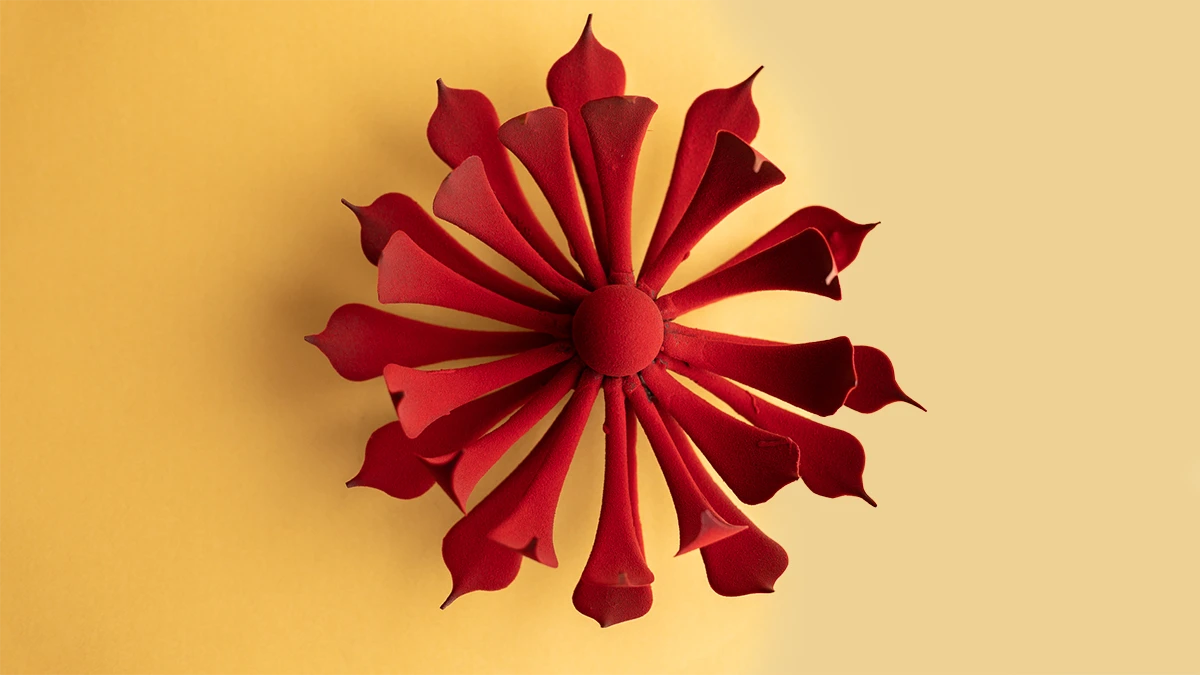
In short: The simplest chocolate decorations are shards, curls, stripes and lace. All of them are made on acetate film or parchment and lifted off once set. Anything that has to snap and shine needs tempered chocolate.
Chocolate as a material
Chocolate is not only a dessert in its own right but an excellent material for decoration, and even beginners can use it to finish pastries, cakes and confectionery. Most of the useful techniques need nothing beyond a spatula and a sheet of acetate.
Shards
Spread tempered chocolate thinly over acetate, let it set and break it into irregular pieces. The most forgiving decoration there is: irregularity is the point, so nothing can go wrong with the shape.
Curls
Spread chocolate on a cold surface, let it firm until it is set but not brittle, then push a scraper across it at a low angle. The temperature window is narrow — too soft and it smears, too hard and it shatters.
Stripes and lace
Pipe chocolate in a fine stream from a paper cornet over acetate, moving quickly and without lifting. Drape the sheet over a rolling pin before it sets and the lace takes a curve.
Storing the pieces
In a closed box at 16–18 °C, away from anything with a smell. The fridge is the wrong place: chocolate takes up moisture there and blooms.
Frequently asked questions
Do chocolate decorations need tempered chocolate
For snap and shine, yes. Untempered chocolate sets matte and melts in your fingers.
What should I make chocolate decorations on
Acetate film: it is flexible and set chocolate releases from it cleanly. Parchment works but gives a duller surface.
How do I store finished decorations
In a closed box at 16–18 °C, away from strong smells. Not in the fridge, where chocolate absorbs moisture and blooms.