

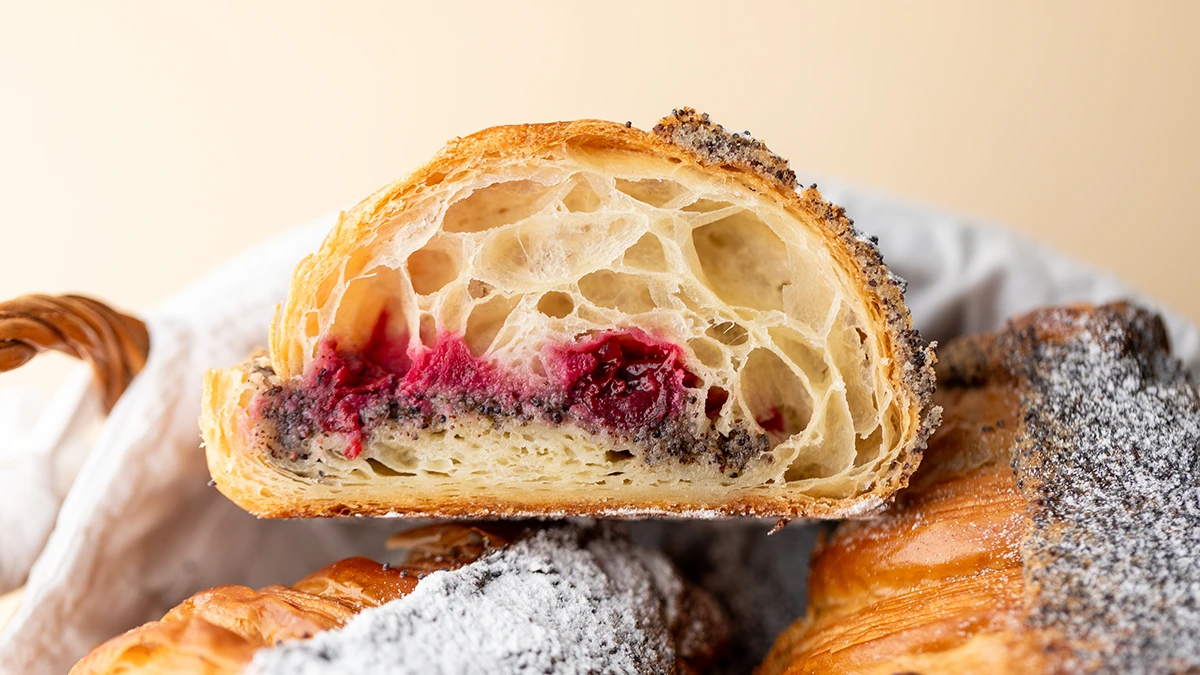
In short: Lamination is one of the most sought-after skills in a bakery and simultaneously the most demanding technically. Master it and you gain not one product but a whole family: croissants, danishes, cubes and swirls.
Why this skill in particular
Pastry has always attracted people who want to turn creative ideas into something real and give others genuine pleasure. If you intend to build a career in that direction, learning to bake croissants is among the more sensible places to put your time.
The reason is that lamination is not a recipe. It is a set of judgements about temperature, timing and feel, and once you have them they transfer to everything built on laminated dough.
What lamination opens up
The same dough, folded and shaped differently, becomes danishes, pain au chocolat, cubes, swirls and kouign-amann. One skill, a whole product line — which matters commercially in a way that a single recipe never does.
Why it cannot be learned from a recipe
Because the numbers change with your kitchen. Butter behaves differently at different room temperatures, flour differs by brand, proving time depends on your oven and your climate. A recipe gives you one set of conditions; understanding gives you all of them.
How long it takes
A first respectable result usually arrives after a few attempts; a consistent one after around ten. That is normal for a technique, and it is worth knowing in advance so the early batches read as progress rather than failure.
Frequently asked questions
What does a croissant course actually teach
Why the dough behaves as it does: temperature, number of folds, proving. Without that, a recipe does not reproduce.
How long does lamination take to learn
A decent result in a few attempts, a consistent one in around ten. It is a technique, not a recipe.
Is the skill useful outside a bakery
Yes: the same dough makes danishes and laminated pastries, and the understanding of temperature transfers to all baking.