

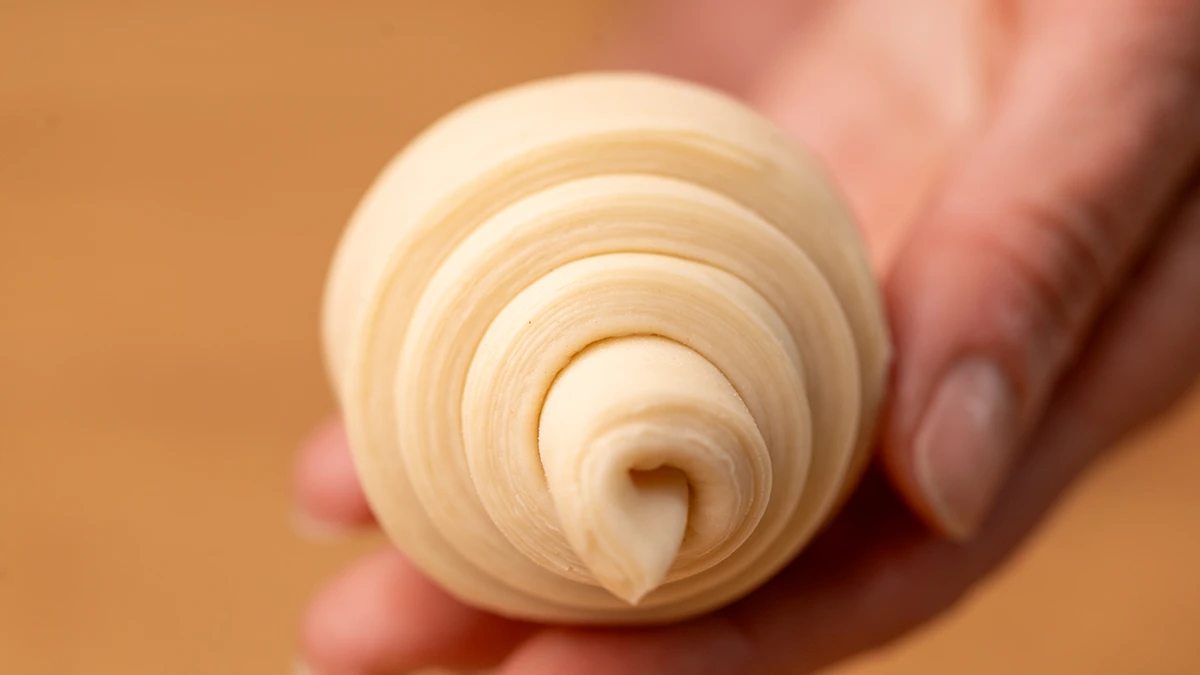
In short: Laminated dough works by rolling a sheet of butter into the dough and folding it, multiplying the layers each time. Three simple folds give 27 layers of butter — enough for a croissant with an open crumb.
Why it matters
Modern pastry is unimaginable without laminated dough. It is the basis of croissants, danishes, puff pastries and a great deal else that is recognised worldwide, and mastering the technology opens all of them at once.
How the layers multiply
Each simple fold triples the number of butter layers: one becomes three, three becomes nine, nine becomes 27. That is why three folds are enough and why a fourth is rarely an improvement — the layers become so thin that they merge, and the crumb closes up.
Yeasted and non-yeasted
Yeasted laminated dough is lifted by both steam and fermentation. This is what croissants and danishes are made from.
Non-yeasted puff pastry rises on steam alone. It goes into vol-au-vents, mille-feuille and savoury pastries.
The temperature rule
The dough and the butter must have the same plasticity, around 14–16 °C. Butter that is too cold shatters and punches through the layers; butter that is too warm smears into the dough and the lamination disappears entirely.
Resting between folds
Chill the dough between folds. Gluten that has been worked resists the rolling pin, and forcing it tears the layers you have just built.
Frequently asked questions
How does yeasted laminated dough differ from puff pastry
In yeasted dough both steam and fermentation lift the layers, which is what makes croissants. Puff pastry rises on steam alone.
How many folds should I do
Three simple folds. More and the layers thin out and merge, leaving a dense crumb.
Why does the butter go into the dough
It was too soft, or the kitchen is too warm. Dough and butter must be at the same plasticity, around 14–16 °C.