

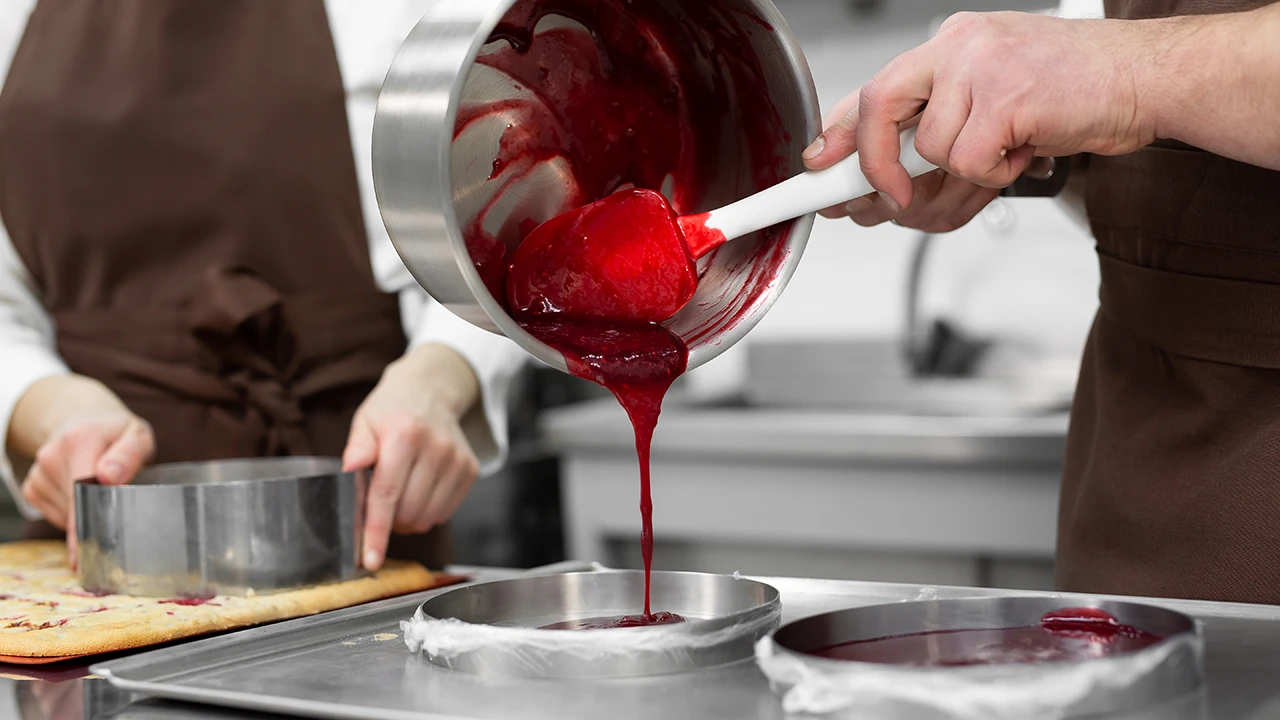
In short: Coulis is a smooth berry or fruit sauce served with desserts. Unlike confit it is not set with a gelling agent and stays pourable; unlike compote it is strained and contains no pieces of fruit.
Where coulis comes from
Coulis first appears in French cooking, where cooks and bakers used the juice and pulp of crushed fruit — berries, sweet fruit and sometimes vegetables — to serve alongside dry dishes such as plain cakes and galettes.
Today it is used everywhere: as a sauce, as a filling, as a layer inside mousse cakes and as a finish for individual desserts — cupcakes, trifles, ice cream.
Coulis, confit and compote
The three are constantly confused, and the difference is simple:
| Texture | Set with | Where it goes | |
|---|---|---|---|
| Coulis | smooth, strained, pourable | nothing | sauce, finishing, plating |
| Confit | holds its shape in a cut | pectin or gelatin | insert inside a cake |
| Compote | pieces of fruit remain | lightly, if at all | filling with texture |
Making coulis
Coulis is not a demanding preparation. Put simply, it is a thoroughly blended, smooth purée with no lumps, cooked briefly with sugar and then passed through a sieve. The sieve is the step that separates a coulis from a compote — skip it and the seeds stay in.
Hibiscus is worth adding to raspberry: it gives acidity and a deeper colour while contributing almost no flavour of its own.
Frequently asked questions
What is the difference between coulis, confit and compote
Coulis is a smooth strained sauce with no gelling agent. Confit is set with pectin or gelatin and holds its shape. Compote keeps pieces of fruit.
Can coulis be thickened
Yes, with a little starch or pectin — but then it is closer to a confit. A classic coulis is meant to pour.
How long does coulis keep
Up to three days refrigerated in a sealed container. It also freezes well in portions.