

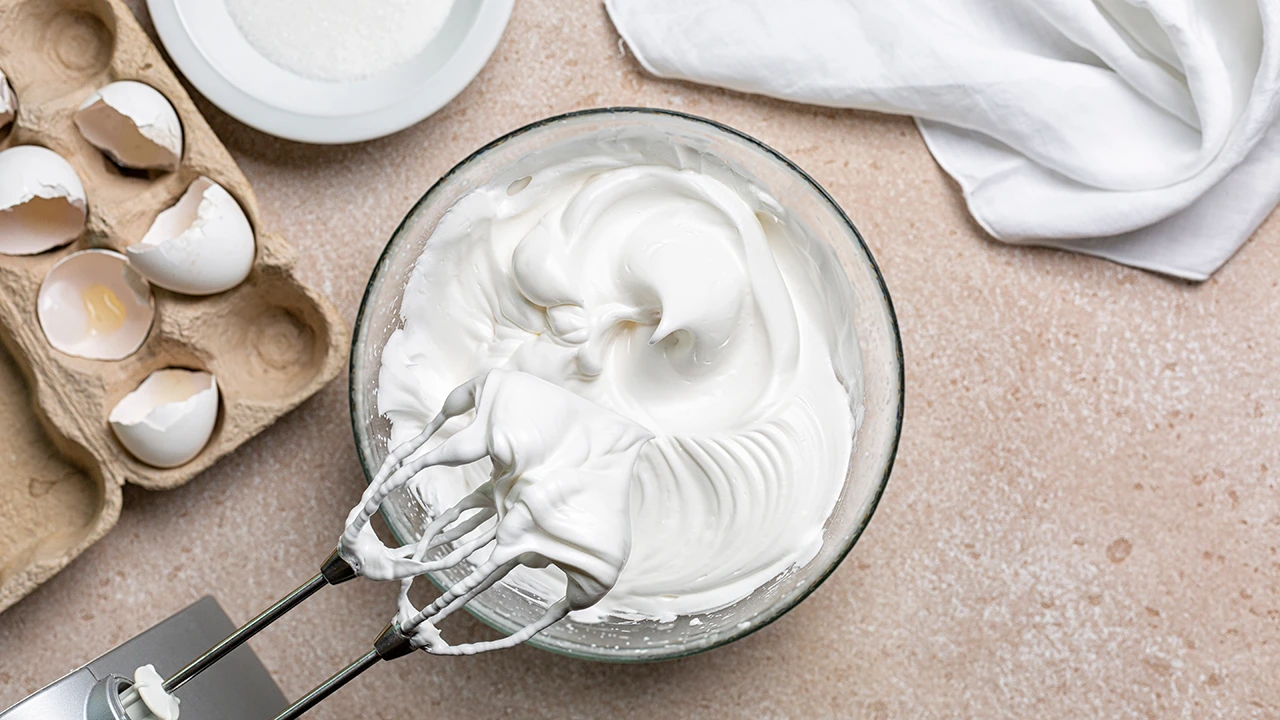
In short: All meringue is egg white and sugar; only the method changes. French is the simplest and is whipped without heat. Swiss is warmed over a bain-marie. Italian is cooked with hot syrup and holds its shape better than either.
French meringue
The easiest of the three to make. All you need is icing sugar and egg white at room temperature. A powerful mixer helps; if yours is not strong, whip in a narrow bowl so the whisk stays in contact with the whites.
French meringue has to be worked fast. Once whipped, transfer it to a piping bag and start immediately — it begins to weep within minutes.
Swiss meringue
The whites and sugar are warmed together over a bain-marie until the sugar dissolves, then whipped off the heat. The warmth dissolves the sugar completely and gives a denser, glossier foam than the French method, stable enough to pipe and hold.
Italian meringue
Hot sugar syrup is poured into the whipping whites in a thin stream. The syrup cooks the protein, which makes this the most stable of the three: it keeps its shape longest and is the usual choice for decoration and for lightening mousses.
Which to use where
| Type | Method | Stability | Best for |
|---|---|---|---|
| French | whipped cold | lowest | baked meringue, macaron shells, quick work |
| Swiss | warmed over a bain-marie | medium | buttercream, piped decoration |
| Italian | cooked with hot syrup | highest | decoration, mousses, marshmallow |
Frequently asked questions
Which meringue is the most stable
Italian: the whites are cooked by hot syrup, so it holds its shape longest and suits decoration.
Which is easiest for a beginner
French — only egg white and icing sugar. A powerful mixer makes it considerably easier.
Why will my meringue not whip
Fat or yolk got into the whites, or the bowl was greasy. Wipe the bowl with lemon juice before you start.