

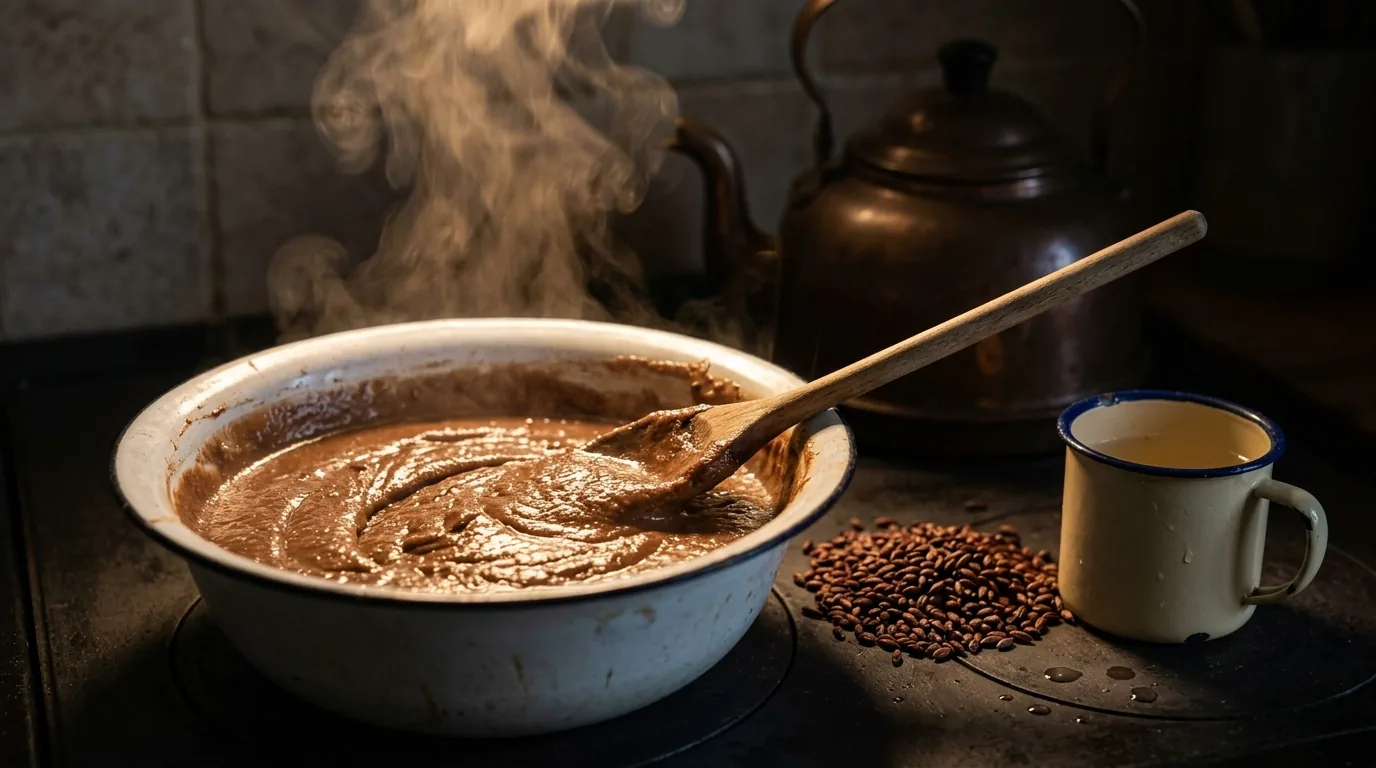
In short: A scald is part of the rye flour brewed with boiling water and held warm. Its starch is partly converted into sugars, which gives sweetness without any sugar, a darker crumb and much longer freshness. Malt in the scald speeds that conversion up and adds flavour and colour.
What happens in a scald
Rye flour is mixed with very hot water, so the starch swells and becomes available to enzymes. The mixture is then held warm for several hours while the enzymes break that starch down into simple sugars. The process is called saccharification, and you can taste it: the scald turns noticeably sweet although no sugar went into it.
The scald is what defines breads like Borodinsky, Lithuanian and the Scandinavian scalded loaves. Without it you get plain rye bread — no worse, but an entirely different thing.
What it gives the bread
Three things at once.
Flavour: sweet notes and a depth you cannot get by adding sugar. Sugar gives sweetness; a scald gives sweetness together with malty, bready aroma.
Crumb: moister and softer, with finer and more even pores. Scalded flour holds a lot of water, and that water stays in the crumb.
Freshness: scalded breads go stale far more slowly. That is exactly why traditional loaves of this kind were not cut on the day of baking — they only improved on the second or third day.
Why malt goes into it
Malt is sprouted and dried grain. Sprouting builds up the enzymes that break starch into sugars, so malt added to a scald makes saccharification faster and deeper.
There are two kinds, and they are not interchangeable.
Unfermented (white) malt is pale and enzymatically active. It is used precisely for that activity — it makes the scald sweet.
Fermented (red) malt is dark and has been heat-treated further. The heat destroys its enzymes but develops colour and a characteristic aroma. It goes in for flavour and a dark crumb, not for saccharification.
Classic Borodinsky formulas use both: red for colour and aroma, white for sugars. Swapping one for the other one-to-one gives a different result.
Molasses, honey and other additions
Rye formulas often include molasses. It brings sweetness, moisture and a soft crumb, but unlike a scald it takes no part in enzyme work — it is simply sugar in liquid form. Honey behaves similarly and adds its own aroma.
Molasses cannot replace a scald: you get the sweetness but neither the crumb structure nor the long freshness.
Scalded bread at home: what to expect
Scalded loaves take longer. The scald itself needs several hours to saccharify before the dough even begins. Hence the four-stage process of traditional breads — starter, scald, sponge, dough — which is why Borodinsky counts as the most demanding loaf a home baker attempts.
Frequently asked questions
Can rye bread be made without a scald
Certainly. The classic rye pan loaf and rye-wheat breads are made without one. A scald is for sweetness, a dark crumb and long freshness.
What can replace fermented malt
Strong malt extract or kvass wort come closest in colour and aroma, though the flavour differs. White malt is not a substitute: the two do different jobs.
Why is a scald sweet if there is no sugar in it
Because enzymes have broken part of the starch into simple sugars — the same process that makes a chewed piece of bread taste sweet.
Does the scald have to be made in advance
Yes, saccharification takes several hours in the warmth. That is why scalded breads are planned across two days rather than one evening.
How much of the dough is scald
In home formulas a scald usually accounts for a noticeable share of the total flour. It is a full part of the dough, not an additive, and it has to be counted in the hydration.