

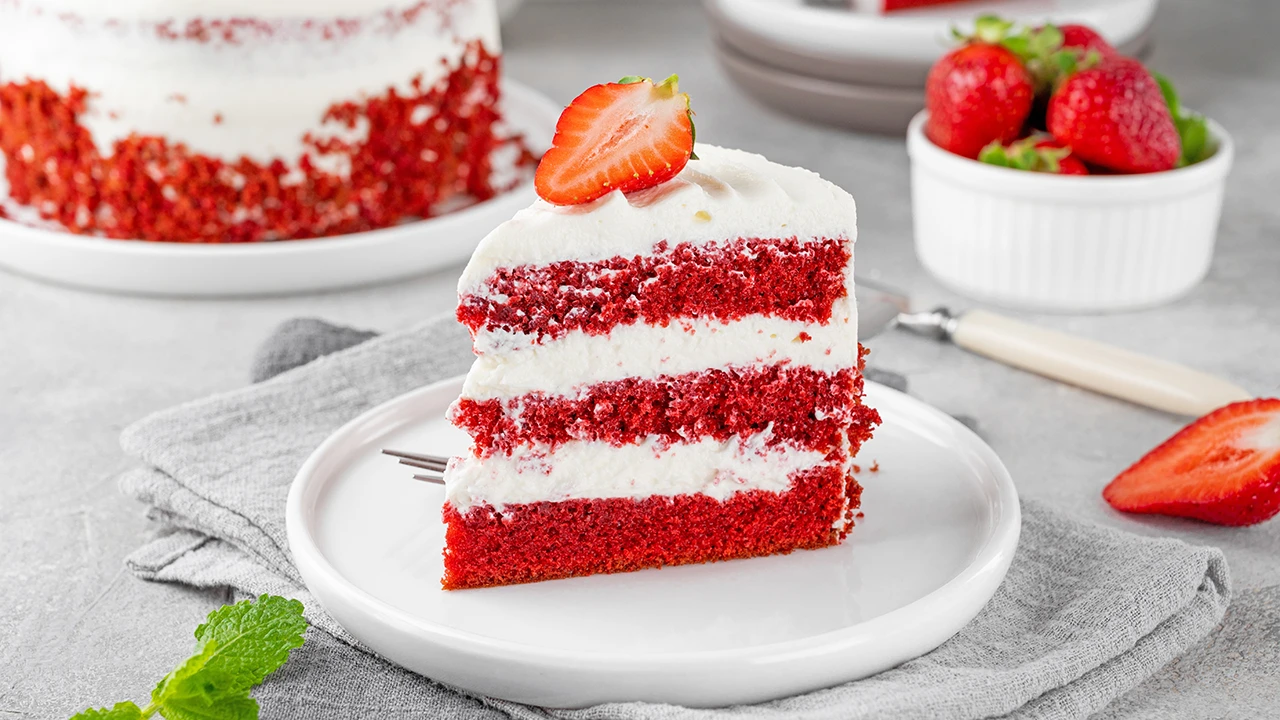
In short: The Red Velvet recipe was first published in a newspaper in the American state of Ohio in the 1950s. The name comes from the velvety texture of the crumb, and the red colour originally came from cocoa reacting with acid rather than from any colouring.
How it started
Red Velvet is among the most distinctive of cakes, and its appearance is what draws people to it. The recipe was first published in a 1950s Ohio newspaper, and it spread quickly thanks to a simple method, a gentle straightforward flavour and, of course, a look that is hard to ignore.
The name itself was already in use by the early twentieth century, attached to cakes whose crumb was notably fine and soft.
Why velvet
The word describes the crumb, not the colour. A properly made Red Velvet has a fine, close, soft texture — the acid in the batter tenderises the flour proteins, which is exactly what produces that quality.
Where the red came from
Originally the colour was a by-product of chemistry. Natural, non-alkalised cocoa contains anthocyanins that turn reddish in an acidic environment — and Red Velvet batter is acidic, with buttermilk and vinegar in it.
Modern cocoa is usually Dutch-processed, which neutralises the acid and kills the reaction. That is why today the colour comes almost entirely from food colouring.
The classic frosting
Cream cheese frosting is the standard pairing, and not by accident: its faint saltiness balances the sweetness of the layers and keeps the cake from being cloying.
Frequently asked questions
Why is it called velvet
For the crumb: fine, close and soft. The acid in the batter tenderises the flour proteins and produces that texture.
Does Red Velvet need food colouring
Today, almost always. The original shade came from natural cocoa reacting with buttermilk and vinegar; Dutch-processed cocoa does not react.
Which frosting goes with Red Velvet
Cream cheese frosting. Its light saltiness balances the sweetness of the layers.