

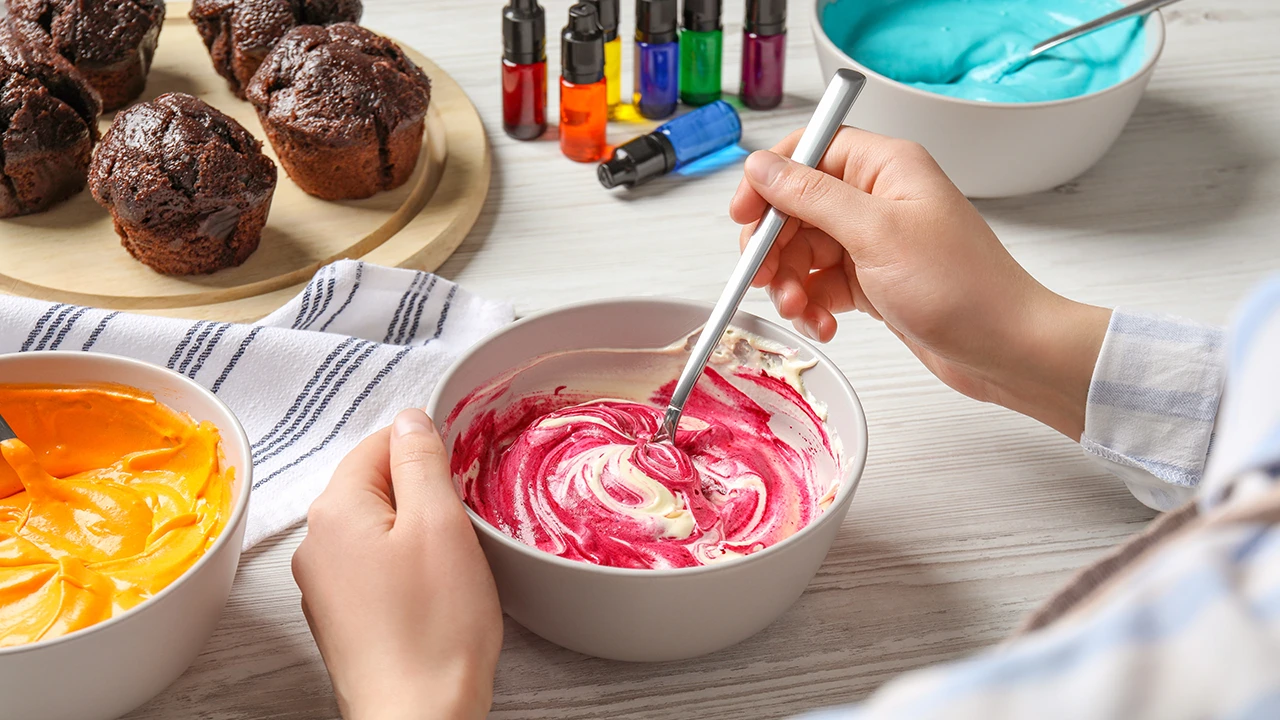
In short: Food colouring is a pigment added to give a product colour. It divides into natural and synthetic, and the choice depends on the medium: water-based mixtures and fat-based ones need different colours entirely.
What colouring is
A food colour is a pigment added to food to give it colour. Colours are present in almost everything we eat, and most of the time we never think about how large a part of daily life they occupy.
Natural colours
Derived from plants, minerals and, occasionally, insects. Gentler in composition, weaker in effect, and less stable under heat and light. They also frequently bring their own flavour, which is a real constraint in delicate desserts.
Synthetic colours
Produced industrially, strong, stable and predictable, and effective in very small quantities. They carry no flavour of their own at working doses.
What the E numbers mean
An E number is a code in the European classification. It signifies that the substance has been through a safety assessment — not, as is often assumed, that it is harmful. Approved colours have permitted usage limits, and those limits are set well below observed effect levels.
How much to use
The minimum that gives the shade you want. Excess colour brings bitterness and alters the texture of the mixture, and an over-coloured dessert reads as artificial before anyone has tasted it.
Frequently asked questions
Are natural colours safer than synthetic
Not automatically. Both go through assessment; natural ones are simply weaker and less stable under heat.
What does the letter E mean in an ingredient list
It is a code in the European classification, indicating the additive has been assessed for safety.
How much colouring should I add
The minimum that achieves the shade, added drop by drop. Excess brings bitterness and changes the texture.
Sources
- EFSA. Food colours — how colours are assessed for safety and what limits apply